
Home education in the UK is growing fast. Over 100,000 children are now registered as home educated, and that number keeps climbing. But 2026 brings real change: mandatory registration is on the horizon, local authorities are asking more questions, and parents want proof that their approach is working. The pressure is real. The good news? With the right practices, the right tools, and a clear plan, you can feel calm, organized, and confident in your child's progress every single day. This guide walks you through everything you need to know, from legal basics to tracking tools and social wellbeing.
Table of Contents
- Understand the UK's home education requirements
- Structure learning: Blend core skills and child-led interests
- Select and optimize resources for UK homeschooling
- Track progress and simplify reporting to authorities
- Foster socialization and wellbeing in the home education journey
- Our perspective: Stop waiting for the perfect system
- ProgressNest helps you stay organized and confident
- Frequently asked questions
Key Takeaways
| Point | Details |
|---|---|
| Know legal duties | Parents must offer efficient, suitable, full-time education and should prepare for future mandatory registration. |
| Blend learning methods | Mix structured teaching with interest-led projects for effective, personalized home education. |
| Track and report smartly | Use apps and portfolios for easy progress tracking and reporting to local authorities. |
| Prioritize mental health | Monitor wellbeing and encourage social opportunities to support your child's emotional growth. |
Understand the UK's home education requirements
Before you plan a single lesson, you need to know where you stand legally. The rules are simpler than many parents expect, but they still matter.
As a parent in the UK, you are responsible for your child's education from age 5 to 16. The law is clear: UK parents must provide an efficient, full-time education suitable to the child's age, ability, aptitude, and any special educational needs, as required by the Education Act 1996. That is your core duty.
What does "full-time" actually mean at home? There are no fixed daily hours. The expectation is that learning is broadly equivalent to what a child would receive in school, but you have total freedom in how you deliver it.
Here is what every UK home educating parent should understand:
- You do not need to follow the National Curriculum. It applies to state schools, not home educators.
- Local authorities (LAs) can make inquiries about whether your child is receiving a suitable education, but they cannot demand access to your home.
- Documentation is not legally required in most of England, but it is increasingly expected, especially as 2026 brings likely mandatory registration closer.
- Children with SEND (Special Educational Needs and Disabilities) have additional considerations, particularly if they have an Education, Health and Care (EHC) plan.
- Flexi-schooling, where a child attends school part-time, is possible but requires the school's agreement.
The EHE census data shows that mental health, SEND needs, and dissatisfaction with school are among the top reasons families choose home education. Understanding your legal position helps you make confident decisions for your child.
Pro Tip: Even if records are not yet mandatory, start building a simple portfolio now. It saves stress later and gives you a clear picture of your child's growth. Check out these beginner home education tips to get started on the right foot.
Structure learning: Blend core skills and child-led interests
Now that you know the rules, it is time to shape how learning actually happens in your home. This is where home education gets exciting.
There is no single right approach. Most families land on what works best for their child through trial and observation. The three main methodologies are:
- Structured learning: Timetables, textbooks, and Key Stage benchmarks for math, English, and science. Great for children who thrive on routine.
- Child-led or unschooling: Learning flows from the child's natural curiosity and interests. Works especially well for neurodiverse learners or highly self-motivated children.
- Eclectic approach: A blend of both. Core subjects get structured time, while projects, field trips, and interests fill the rest. As research shows, eclectic is most popular among UK home educators, combining structure for core skills with flexible, interest-driven learning.
Here is a practical way to think about it:
"Give your child a strong foundation in literacy and numeracy, then let their curiosity lead the way everywhere else."
This balance keeps learning purposeful without feeling rigid. You cover what matters most, and your child stays engaged because they have real ownership over parts of their day.
A few things to keep in mind when planning:
- Pace matters more than curriculum. Moving at your child's speed is one of home education's biggest advantages.
- Key Stages are useful guides, not rigid requirements. They help you check that core skills are developing on track.
- Projects and real-world learning count. A child who builds a birdhouse is learning math, planning, and science at once.
Pro Tip: Review your approach every term, not just at the start of the year. Children's interests and learning styles shift quickly, especially between ages 7 and 12. Browse more home education guides for fresh ideas each season.
Select and optimize resources for UK homeschooling
Great resources make a real difference. The right tools save you time, keep your child engaged, and fill gaps in your own subject knowledge.
Here is a breakdown of the best free and paid options available to UK home educators:
- BBC Bitesize: Free, curriculum-aligned, and excellent for ages 5 to 16 across all core subjects.
- Oak National Academy: Free video lessons and downloadable resources, organized by year group and subject.
- Twinkl: Paid subscription with thousands of printable worksheets, lesson plans, and activity packs.
- EdPlace: Paid platform with adaptive worksheets and progress tracking, great for structured learners.
- Online schools such as Queens: Offer live lessons, qualified teachers, and accredited programs for families wanting more formal support.
Research shows that 70% use textbooks and workbooks as part of their home education, alongside digital tools. Print and screen together tend to work better than either alone.
| Resource | Cost | Best for | Age range |
|---|---|---|---|
| BBC Bitesize | Free | Core subjects, revision | 5 to 16 |
| Oak National Academy | Free | Structured lessons | 4 to 16 |
| Twinkl | Paid | Activities, worksheets | 3 to 16 |
| EdPlace | Paid | Progress tracking | 5 to 16 |
| Queens Online School | Paid | Live teaching, exams | 11 to 18 |
Do not forget your local library. Many UK libraries offer free access to digital learning platforms, physical books, and even coding clubs. Local home education co-ops are also worth joining. They pool resources, share expertise, and give your child regular group learning time.
Match your resources to your chosen method. A child-led learner may thrive with documentary series and project kits. A structured learner may prefer a clear workbook sequence. Visit educational resource guides for curated recommendations by age and subject.
Track progress and simplify reporting to authorities
Knowing your child is progressing is one of the most reassuring feelings in home education. But it is also one of the areas parents find hardest to manage without a system.
Here is what to keep in your records:
- A brief educational philosophy statement. One page explaining your approach and goals.
- Subject overviews. A simple list of topics covered each term.
- Work samples. Photos, drawings, written work, or project outputs.
- Resource lists. Books, websites, and tools used.
- Progress notes. Short observations about what your child has mastered or is working toward.
Digital tools make this far easier than it sounds. The Strew app and platforms like ProgressNest help you log milestones, track patterns, and generate reports without wrestling with spreadsheets. Tech genuinely eases admin and is vital for LA inquiries.

| Method | Effort level | Best for | LA-ready? |
|---|---|---|---|
| Paper portfolio | Medium | Child-led learners | With effort |
| Work journal | Low | Structured learners | Yes |
| Progress tracking app | Low | All approaches | Yes, easily |
| Online quizzes/benchmarks | Low | Core subject checks | Partial |
With mandatory registration likely coming in 2026, building good habits now puts you ahead of the curve. You will not be scrambling to pull records together at short notice. Instead, you will have a calm, organized picture of your child's learning journey ready to share.
Explore tracking child progress and milestone tracking tools to find the approach that fits your family best.
Foster socialization and wellbeing in the home education journey
Academic progress matters. But so does your child's happiness, friendships, and sense of belonging. These are not extras. They are essential.
The socialization question is one of the most common concerns parents hear from family and friends. The reality? Home educated children can have rich, varied social lives. It just takes a little more intentional planning.
Here are practical ways to build social connection:
- Join a local home education group. Most areas have active groups that organize field trips, sports days, and group lessons.
- Use online communities. Facebook groups, Discord servers, and forums connect you with thousands of UK home educating families.
- Schedule regular activities. Weekly sports, drama clubs, music lessons, or art classes provide consistent peer interaction.
- Consider flexi-schooling if your child wants more peer time. It is not always available, but it is worth exploring.
- Monitor mental health closely. For many families, mental health was the reason they chose home education. Keep checking in.
"The goal is not to replicate school at home. It is to build a life where your child feels safe, curious, and connected."
Research shows that 32% prefer school specifically for peer interaction, which confirms that socialization is a genuine consideration, not just a myth. But it also means that with intentional effort, you can meet that need outside of a traditional school setting. Find support for social-emotional learning to help your child thrive beyond academics.
Our perspective: Stop waiting for the perfect system
Here is something we see often. Parents spend weeks researching curricula, comparing apps, and planning elaborate timetables before they ever start. Then they feel paralyzed when real life does not match the plan.
The truth is, the best home education system is the one you actually use. A simple notebook and a few good conversations with your child will teach you more about what works than any framework will.
What actually makes a difference over time is consistency and observation. Not perfection. You do not need to cover every topic in a given week. You do need to notice when your child is struggling, when they are bored, and when they are genuinely lit up by something.
Tracking progress is not about proving yourself to an authority. It is about understanding your child better. When you can see patterns in how they learn, you make better decisions. That is the real value of good records.
Start small. Build momentum. Adjust as you go. That is the approach that works.
ProgressNest helps you stay organized and confident
If you are ready to take the stress out of tracking and reporting, ProgressNest was built for exactly this.
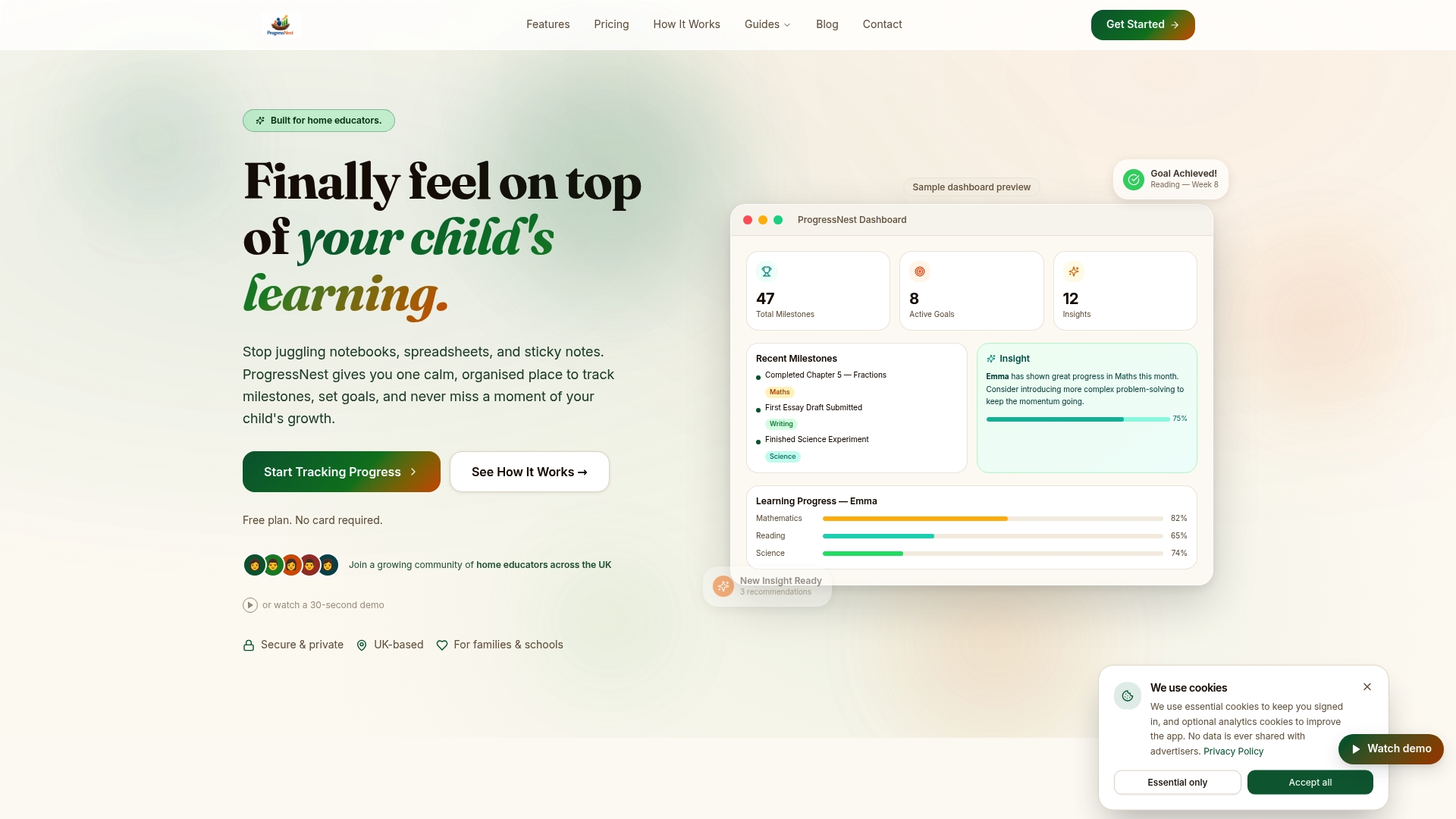
ProgressNest is a simple, secure platform designed for UK home educators. You can log milestones, set learning goals, and generate professional PDF reports in minutes, with no spreadsheets needed. Visual charts show you patterns across subjects and over time, so you always know where your child stands. Whether you are managing one child or several, ProgressNest keeps everything organized in one place. It is easy to use, private by design, and built around the way home educators actually work. Start your free trial today and see how calm and organized home education management can feel.
Frequently asked questions
Is home education legal in the UK in 2026?
Yes, home education is fully legal in the UK. You must ensure your child receives a suitable full-time education and, with mandatory registration likely in 2026, you should be prepared to register with your local authority.
What records do I need for my child's home education?
Keep work samples, resource lists, a brief educational philosophy statement, and subject overviews. Using a progress tracking app or platform makes it easy to stay organized and respond confidently to any local authority inquiries.
How can I ensure my child is progressing at home?
Mix structured lessons with child-led activities, and review progress regularly using digital tools or milestone checklists. Research shows 83% of UK homeschoolers feel confident in their child's progress when using a consistent approach.
How do I address socialization for my homeschooled child?
Join local home education groups, schedule weekly activities like sports or arts, and use online communities for connection. Hybrid and flexi-school options can also bridge any gaps in peer interaction when needed.
Recommended
- How to Track Your Child's Educational Progress at Home | ProgressNest
- Educational Milestone Tracker for Children | ProgressNest — UK Parents & Home Educators
- 7 Things Every Home Educating Parent Wishes They'd Known Sooner | ProgressNest Blog
- Child Development Tracker for Parents | Monitor Growth & Learning | ProgressNest