How do you set clear, realistic educational goals when you're juggling two, three, or even four children at different stages? It's one of the most common challenges UK home educators face. Vague aims like "learn more math" or "read better" don't give you or your child anything to work toward. You need specific, trackable targets that actually fit each child's age and ability. This article gives you practical educational goals examples across key UK learning stages, plus strategies for coordinating them across multiple children, so you can feel organized, confident, and calm about your home education journey.
Table of Contents
- Key criteria for effective educational goals at home
- Practical educational goals examples by age group
- Comparison: Sample goals for multiple children in one home
- How to track and evidence progress at home
- Our experience: Flexibility, not perfection, powers effective home education
- Take your home education tracking to the next level with ProgressNest
- Frequently asked questions
Key Takeaways
| Point | Details |
|---|---|
| Set goals by age | Tailor educational goals to each child’s age and needs using UK-relevant milestones for effective progress. |
| Use SMART frameworks | Applying SMART criteria keeps goals clear, measurable and achievable for older children. |
| Track with portfolios | Portfolios and observation logs offer meaningful, flexible evidence of home education progress. |
| Combine and stagger for families | Staggering core subjects and combining topics help manage multiple children’s learning. |
| Flexibility outperforms perfection | Adapt your systems to the realities of home life—small wins and visible growth matter more than rigid benchmarks. |
Key criteria for effective educational goals at home
Before exploring specific age examples, it helps to understand what makes an educational goal actually work in a home setting. Not all goals are created equal. A goal that's too vague leads to drift. One that's too ambitious leads to burnout. The sweet spot is a goal that's clear, realistic, and tied to something meaningful for your child.
Here are the key criteria to build goals that stick:
- Be specific. "Improve reading" is too broad. "Read one chapter book per month" gives you something to measure.
- Make it measurable. You need to know when a goal is met. Numbers, dates, and observable outcomes help.
- Keep it achievable. Set targets that stretch your child without overwhelming them.
- Make it relevant. Goals should connect to your child's current interests and developmental stage.
- Set a time frame. Open-ended goals rarely get done. A deadline creates momentum.
This is the SMART goals framework, and it works especially well for children aged 8 and up who can participate in setting their own targets.
One thing that surprises many UK home educators is that suitable education is described as broad, balanced, and differentiated, with no National Curriculum required. That's actually great news. It means you have real flexibility to build goals around your child's strengths and your family's rhythm.
Portfolio evidence, like writing samples, project logs, and photos of hands-on work, often matters more than test scores. When you track child progress consistently, you build a rich picture of learning over time.
"The best goals are the ones your child helps create. When they own the target, they're far more likely to reach it."
Pro Tip: Write your goals on a whiteboard or sticky notes and put them somewhere visible. Review them every two to four weeks. Seeing progress builds confidence for both you and your child.
Practical educational goals examples by age group
With goal-setting criteria established, here are hands-on examples across common UK age bands. These cover literacy, math, science, social skills, and enrichment. Use them as starting points and adapt freely.
| Age group | Literacy goal | Math goal | Enrichment goal |
|---|---|---|---|
| 4 to 5 | Recognize all 26 letters by end of term | Count to 20 and identify basic shapes | Complete one nature walk per week |
| 5 to 7 | Read simple sentences independently | Add and subtract within 20 | Learn one new song or poem per month |
| 8 to 10 | Write a short story with a beginning, middle, and end | Multiply and divide up to 12x12 | Start a simple science experiment journal |
| 11 to 14 | Write a structured essay on a chosen topic | Understand fractions, decimals, and percentages | Complete an online art or coding module |
| 14 to 16 | Analyze a text and write a critical response | Work through GCSE-level algebra topics | Pursue a personal project or volunteer role |
These age-specific aims cover communication, math operations, and enrichment activities that keep learning broad and balanced.
A few additional goals worth considering:
- Social skills: Attend one group activity or co-op session per week
- Physical development: Complete 30 minutes of active play or sport daily
- Independence: Manage a personal reading log or project notebook
One often overlooked strategy is the unit study approach. You pick one theme, say ancient Egypt, and each child explores it at their own depth. Your 6-year-old draws pyramids and learns about the Nile. Your 12-year-old researches trade routes and writes a report. Same topic, different goals, one family. You can find free art and science enrichment resources to support this approach.
Pro Tip: Use your milestone tracker examples to log completed goals and spot patterns. You'll quickly see which subjects need more attention and which are thriving. For more ideas, browse our home education tips to keep your planning fresh.
Comparison: Sample goals for multiple children in one home
Having seen individual age goals, let's look at how to coordinate them in a real-world multi-child home. This is where things can feel complicated, but a little structure goes a long way.
Here's an example with three children: Maya (age 6), Sam (age 10), and Priya (age 13).
| Subject | Maya (age 6) | Sam (age 10) | Priya (age 13) |
|---|---|---|---|
| Literacy | Read 3 picture books per week | Write a book review monthly | Analyze a short story and discuss themes |
| Math | Count and sort objects to 50 | Practice times tables to 12x12 | Solve multi-step word problems |
| Science | Observe and draw one plant weekly | Keep a weather journal for one month | Design a simple experiment with hypothesis |
| Enrichment | Learn a nursery rhyme in French | Build a model from recycled materials | Research and present on a chosen topic |
Here's how to make this work day to day:
- Stagger core subjects. Start Maya with phonics while Sam does independent math. Then switch. This avoids the chaos of everyone needing you at once.
- Use independent work slots. Older children like Priya can work solo for 45 to 60 minutes. Use that time for hands-on work with younger ones.
- Combine where you can. History, geography, and art lend themselves to group learning. Read aloud together, then each child responds at their own level.
- Keep it realistic. Formal learning for primary-age children works best at 2 to 4 hours per day. Don't try to replicate a school day.
When you organize multi-child learning with a clear dashboard or planner, you stop relying on memory and start making intentional choices. That shift alone reduces daily stress significantly.
How to track and evidence progress at home
Once your goals are coordinated, the next step is measuring and demonstrating ongoing progress with confidence. This matters for your own peace of mind and for any conversations with your Local Authority (LA).
Here are the most effective ways to track progress at home:
- Portfolio collections: Save writing samples, drawings, photos of projects, and experiment results. Date everything. A simple folder per child per term works well.
- Observation logs: Jot down what you notice during learning sessions. "Today Sam explained long division to his sister" is valuable evidence.
- Periodic reviews: Every four to six weeks, sit down and check each goal. What's been met? What needs more time? Adjust without guilt.
- Learning apps and tools: Portfolios, observation logs, and tools like Strew help track home education progress over time and keep evidence organized.
Pro Tip: Create a simple weekly review habit. Every Friday, spend 10 minutes adding one piece of evidence per child to their portfolio. Small, consistent steps build a strong record.
What do LAs actually want to see? Most want evidence that your child is receiving a suitable, broad education. They're not looking for perfection. They want to see that learning is happening, that it's appropriate for the child's age and ability, and that you're actively involved.
"You don't need a perfect system. You need a consistent one. Even a simple notebook kept regularly tells a powerful story of progress."
When you use a student progress monitoring approach that fits your family, evidence gathering stops feeling like a chore and starts feeling like a natural part of your week. Linking your goals to track learning progress tools makes the whole process easier and more reliable.
Our experience: Flexibility, not perfection, powers effective home education
Here's something most goal-setting guides won't tell you: some of your best home education days will look nothing like your plan. The science experiment that goes sideways and sparks a two-hour conversation. The math lesson that gets abandoned because your child is finally ready to read independently. These moments are not failures. They are the point.
We've seen families tie themselves in knots trying to hit every goal every week. The result is stress, not learning. The families who thrive are the ones who build flexible systems. They use unit themes, independent work slots, and simple learning logs. They celebrate small wins. They adjust goals without shame.
Good enough is genuinely good enough on a hard day. What matters is that learning is happening consistently over weeks and months, not that every Tuesday looks identical. Build recording habits that actually work for your family, and explore practical home education lessons that fit your real life, not an idealized version of it.
Take your home education tracking to the next level with ProgressNest
Setting goals is the first step. Keeping track of them across multiple children is where many parents feel stuck. ProgressNest makes that part easy.
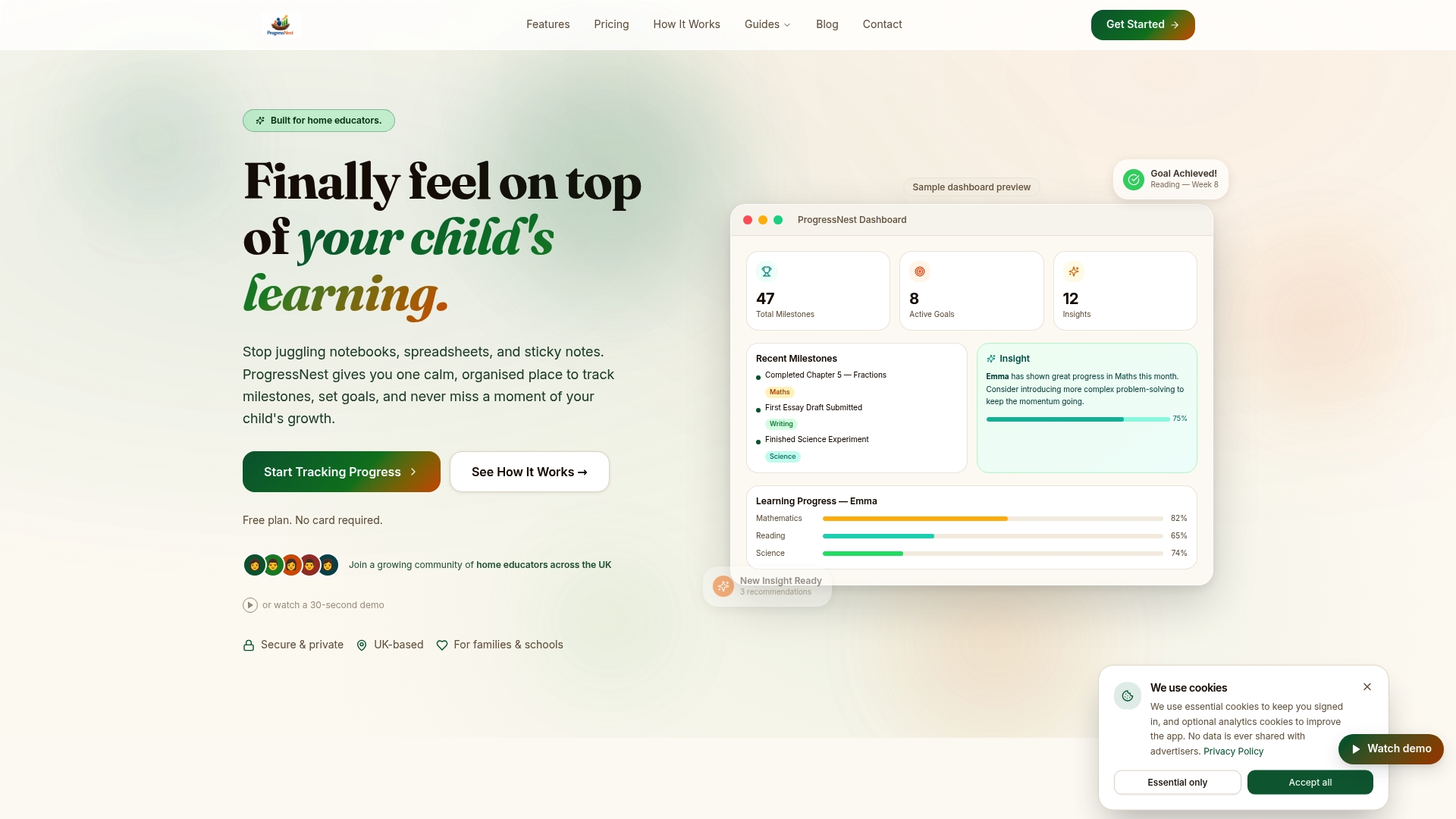
With ProgressNest, you can build a portfolio for each child, log milestones as they happen, and generate professional PDF reports when you need them. Your child development tracker keeps every goal visible and every win recorded. The parent dashboard gives you a calm, clear view of all your children's progress in one place. No spreadsheets. No stress. Just a simple, secure system that grows with your family. Try it free today.
Frequently asked questions
What are examples of SMART educational goals for UK home education?
A SMART goal might be "Read one book per week for four weeks" or "Complete key stage 2 times tables by June." SMART goals for older children are recommended for progress tracking because they give both parent and child a clear target to work toward.
Do I need to follow the National Curriculum when home educating in the UK?
No, but using it as a reference point for age-appropriate goals can be helpful. No National Curriculum is required, but Local Authorities want to see suitable education, not specific benchmarks.
What evidence should I keep to show my child's progress?
Keep portfolios of work, observation notes, and periodic review summaries. Portfolio and observation logs are effective for showing home education progress, and apps can help document everything consistently.
How many hours should UK home educated children study each day?
Typically, 2 to 3 hours per day for ages 5 to 7 and 3 to 4 hours per day for ages 8 to 10 are effective. 2 to 4 hours formal learning per day for primary-age children is a practical and widely used guideline, but flexibility is always key.
Recommended
- Blog — Home Education Tips & Child Progress Guides | ProgressNest
- Educational Milestone Tracker for Children | ProgressNest — UK Parents & Home Educators
- How to Track Your Child's Educational Progress at Home | ProgressNest
- 7 Things Every Home Educating Parent Wishes They'd Known Sooner | ProgressNest Blog