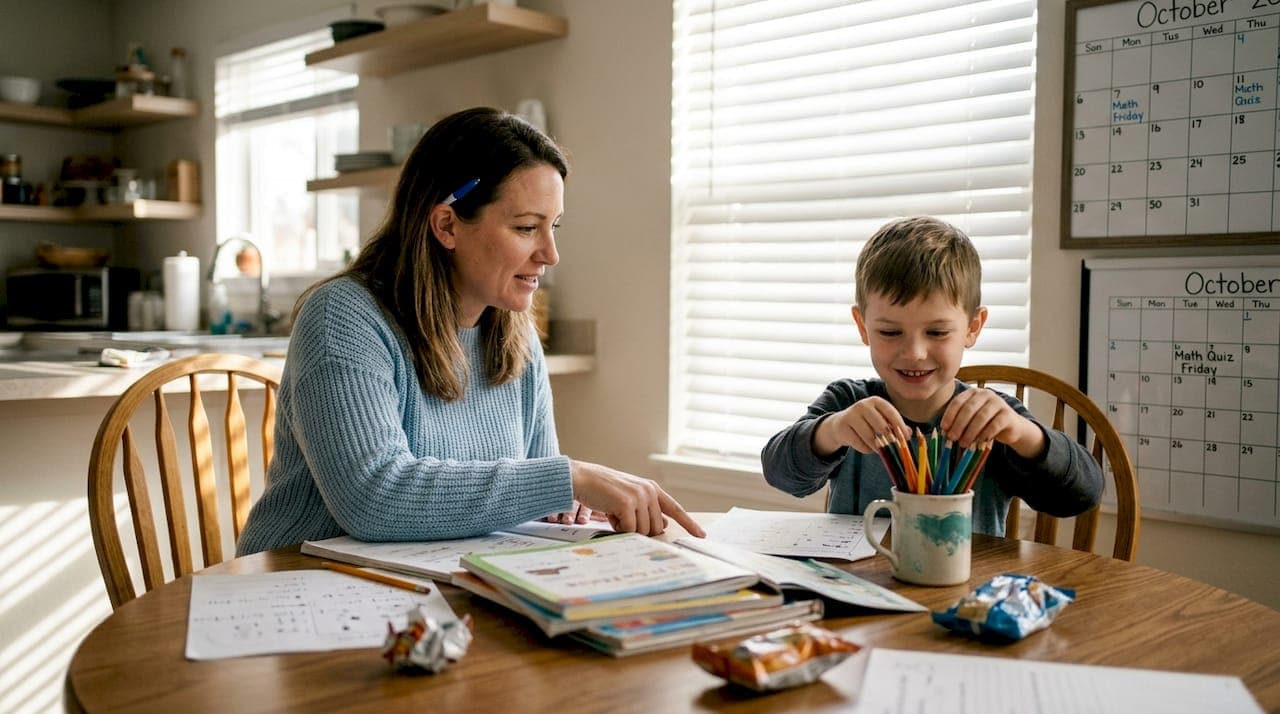
If you're new to home education in the UK, you've probably already run into a wall of unfamiliar terms. Elective Home Education is the official term used when parents choose to educate their child at home rather than sending them to school full time. But you might also hear "homeschooling," "EHE," "deregistration," or "EHCP" thrown around, often without explanation. Getting these terms straight is not just helpful. It's essential. Knowing the correct language helps you understand your rights, meet your legal duties, and communicate confidently with your local authority (LA). This guide breaks it all down clearly.
Table of Contents
- Core home education terms every parent should know
- Legal framework and responsibilities in home education
- SEND, EHCP, EOTAS, and other specialist terminology
- Philosophies, approaches, and key terms in practice
- When terminology matters: Dealing with local authorities and beyond
- Our take: Why understanding the language of home education empowers families
- Support your home education journey with expert tools
- Frequently asked questions
Key Takeaways
| Point | Details |
|---|---|
| Know key terminology | Understanding terms like EHE, deregistration, and EHCP is vital for UK home educators. |
| Legal basics matter | Parents are required to provide suitable, full-time education—but not required to follow school hours or curricula. |
| Special needs clarity | EHCPs and SEND terms affect support options for home-educated children, so precise language is essential. |
| LA processes explained | Annual checks by local authorities use official terminology—being fluent in these terms avoids misunderstandings. |
| Equip for success | The right vocabulary helps parents advocate effectively and organize their child's home learning. |
Core home education terms every parent should know
Let's start with the basics. The language around home education can feel overwhelming at first, but once you see each term in plain English, it all starts to make sense.
Elective Home Education (EHE) is the official UK term for a parent's choice to educate their child at home. "Homeschooling" is widely used in conversation but is not the legal term. Both mean the same thing in practice. Knowing the official label matters when you're reading guidance documents or writing to your LA.
Here are the key terms you'll encounter most often:
| Term | What it means |
|---|---|
| EHE | Elective Home Education: the official term for parent-led home learning |
| Deregistration | The formal process of removing your child from a school roll |
| LA | Local Authority: your regional council, responsible for education oversight |
| National Curriculum | The government's framework for what schools teach; home educators are not required to follow it |
| Flexi-schooling | A part-time arrangement where a child attends school some days and is home educated on others |
One of the most important things to understand is that school is not mandatory, but education is. That distinction gives you real freedom in how you structure your child's learning. You can follow the National Curriculum closely, or you can take a completely different path.
For practical home education tips on structuring your approach, it helps to explore what other families are doing. And once you're underway, milestone tracking can help you see your child's progress clearly over time.
- EHE covers all forms of home-based education, from structured lessons to child-led learning.
- Deregistration is required if your child is currently enrolled in a school.
- Flexi-schooling requires agreement from the school and is not a legal right.
- The National Curriculum is a useful reference, but it's optional for home educators.
Pro Tip: Before you start EHE, check your LA's deregistration process. Some authorities have specific forms or timelines, and knowing these in advance avoids unnecessary back-and-forth.
Legal framework and responsibilities in home education
Understanding these terms starts with their foundation in UK law and how responsibilities break down for parents.
The key piece of legislation is Section 7 of the Education Act 1996. It states that parents must provide an efficient, full-time education suitable to the child's age, ability, aptitude, and any special educational needs. Three words in that sentence carry a lot of weight: efficient, full-time, and suitable.
"The law does not define 'full-time' in hours, nor does it prescribe a curriculum. It requires that the education be efficient, meaning it achieves what it sets out to achieve, and suitable to the individual child."
"Suitable" means tailored to your child's specific needs, not a one-size-fits-all program. "Efficient" means your approach actually works. "Full-time" is not defined in hours by law, which gives you flexibility in how you organize your days.
If your child is currently in school, you must notify the headteacher in writing to deregister them. Here are the steps to start EHE legally:
- Write a deregistration letter to your child's current school headteacher.
- Keep a copy of the letter for your records.
- Notify your LA that you are home educating (not legally required in most cases, but recommended).
- Begin planning your educational provision.
- Keep written records of your child's learning from day one.
LAs can check in on your provision to ensure it's suitable. You can find EHE statistics from the Department for Education to understand how many families are in the same position as you. Our practical blog guides also walk through many of these steps in detail.
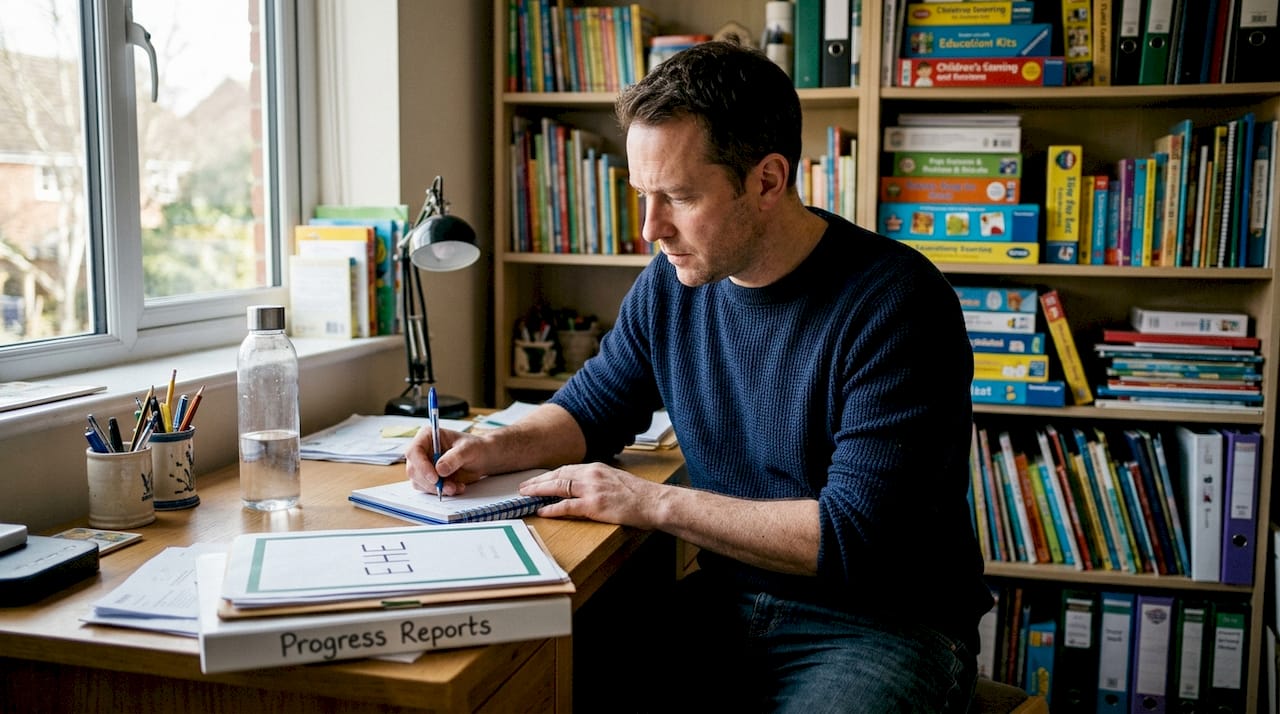
Pro Tip: Keep detailed written records of your child's learning activities, resources used, and progress made. This documentation is your strongest tool if the LA ever questions the suitability of your provision.
SEND, EHCP, EOTAS, and other specialist terminology
Navigating home education can be especially challenging when special needs terminology enters the picture.
These are the key terms every home-educating parent with a child who has additional needs should know, drawn from the SEND glossary:
- SEND: Special Educational Needs and Disabilities. An umbrella term covering a wide range of learning differences and physical or mental health needs.
- SEN: Special Educational Needs. Often used interchangeably with SEND.
- EHCP: Education Health Care Plan. A legal document that outlines a child's needs and the support they should receive.
- EOTAS: Education Otherwise Than At School. A formal arrangement where the LA funds education outside a school setting, often for children who cannot attend school.
It's worth knowing that 16% of EHE children have SEN support needs, and 7% have an EHCP. Both figures are higher than school averages. This tells us that many families turn to home education precisely because mainstream school isn't meeting their child's needs.
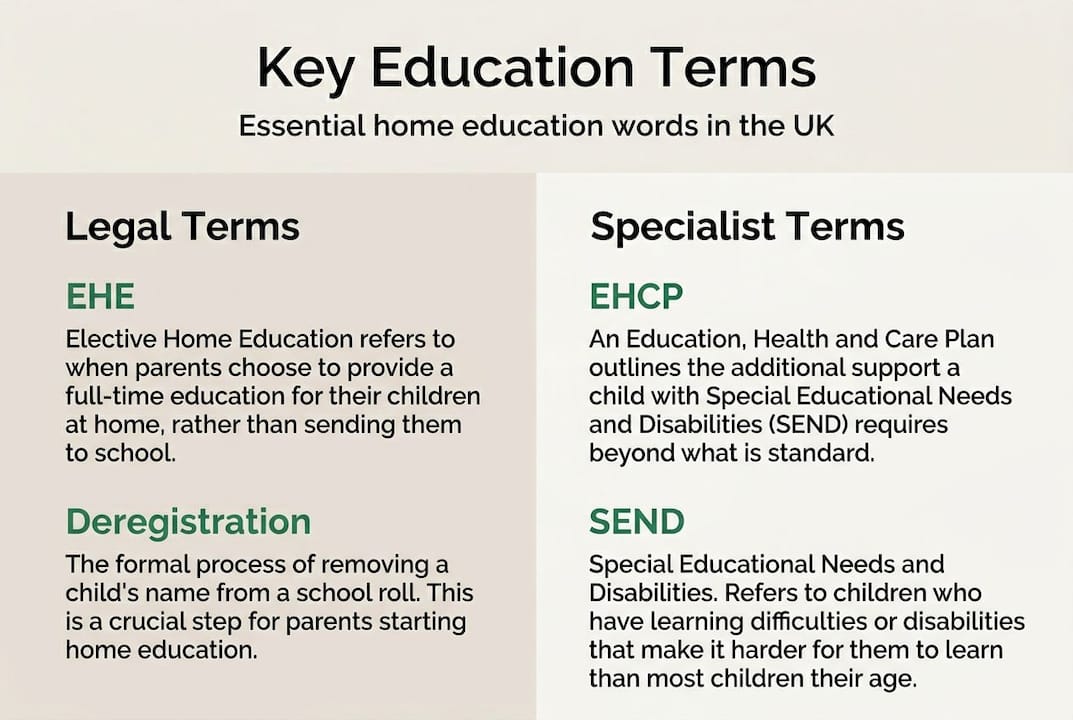
Here's how these arrangements compare:
| Arrangement | Who initiates it | LA funding involved | Curriculum freedom |
|---|---|---|---|
| EHE | Parent | No | High |
| EOTAS | LA | Yes | Moderate |
| CME (Children Missing Education) | LA concern | N/A | N/A |
If your child has or may need an EHCP, here's what to keep in mind:
- You can request an EHC needs assessment from your LA at any time.
- An existing EHCP does not prevent you from choosing EHE.
- If you home educate and your child has an EHCP, the LA retains some responsibilities for provision.
- Review the EHCP annually and request amendments if your child's needs change.
Using a child development monitoring tool can help you track your child's progress against the goals set out in their EHCP, making annual reviews much easier to prepare for.
Philosophies, approaches, and key terms in practice
Terminology isn't just legal. It's embedded in how you plan and deliver education daily.
Home education sits on a wide spectrum. On one end, you have structured approaches that mirror school, often aligned with Key Stages (the government's age-based learning stages). On the other end, you have autonomous learning or "unschooling," where the child leads their own education based on interests and curiosity.
Here are the main philosophies and what they look like in practice:
- Structured: Follows a set timetable, often aligned with Key Stage content. Works well for families planning GCSE exams.
- Semi-structured: A blend of planned lessons and child-led exploration. Common among families who want flexibility without losing direction.
- Autonomous: Child-driven learning with minimal adult-imposed structure. Relies on the child's natural curiosity.
- Unschooling: A philosophy that rejects formal curriculum entirely, trusting that real-life experiences provide sufficient education.
Two terms you'll encounter when thinking about exams are private candidate and Key Stage. A private candidate is a student who sits public exams (like GCSEs) without being enrolled in a school. Home-educated children often take this route. Home education offers curriculum freedom but requires demonstrating suitability if the LA queries your provision. Structured approaches tend to make exam preparation more straightforward.
Importantly, LAs cannot mandate which curriculum or philosophy you follow. They can only intervene if they believe your education is inefficient or unsuitable. Keeping clear records of tracking child progress helps you demonstrate suitability in any format.
For further context on recognized approaches, the EHE methodology guidance from the Department for Education is a useful reference point.
When terminology matters: Dealing with local authorities and beyond
A firm grasp of terminology becomes critical when you're asked to describe or defend your child's education to others.
Most LAs will make annual contact with home-educating families to check that provision is suitable. This might be a letter, a phone call, or a request for a meeting. Knowing how to respond calmly and correctly makes a real difference.
"We are writing to request information about the educational provision being made for your child, as part of our duty under Section 437 of the Education Act 1996 to ensure that children in our area are receiving a suitable education."
That kind of letter can feel alarming. But if you know your rights and your terminology, it's manageable. LAs may monitor suitability annually, but you are not required to allow them access to your child. You can respond in writing with a summary of your provision instead.
Here's what to do if your LA contacts you:
- Read the letter carefully and identify exactly what is being requested.
- Respond in writing within the timeframe given, using official terminology.
- Provide a clear summary of your educational provision, including subjects, resources, and methods.
- Do not feel pressured to arrange a home visit if you are not comfortable.
- Seek advice from a home education support group if you are unsure how to respond.
If an LA decides your provision is unsuitable, they can issue a notice that may lead to a School Attendance Order. This is rare, but knowing the process helps you avoid it. Your parent progress dashboard can help you compile organized, clear records quickly when you need them most.
Our take: Why understanding the language of home education empowers families
Here's something we've noticed: families who invest time in learning the official language of home education tend to feel more confident across the board. Not just in LA meetings, but in their daily planning and in their own sense of purpose.
When you use terms like "suitable provision" or "efficient education" correctly, you're not just ticking a box. You're signaling to yourself and to others that you understand what you're doing and why. That matters more than people realize.
We've also seen that families' approaches evolve as their understanding grows. A parent who starts with a rigid structured plan often discovers, after six months of further reading on home education, that a semi-structured approach fits their child better. That shift happens because they understand the terminology well enough to make an informed choice, not just follow a template.
The language of home education is not a barrier. It's a tool. Once you own it, you feel calmer, more organized, and far more prepared for whatever comes next.
Support your home education journey with expert tools
Mastering these terms is a great first step. The next is putting them into practice with tools that make your daily organization easy and stress-free.
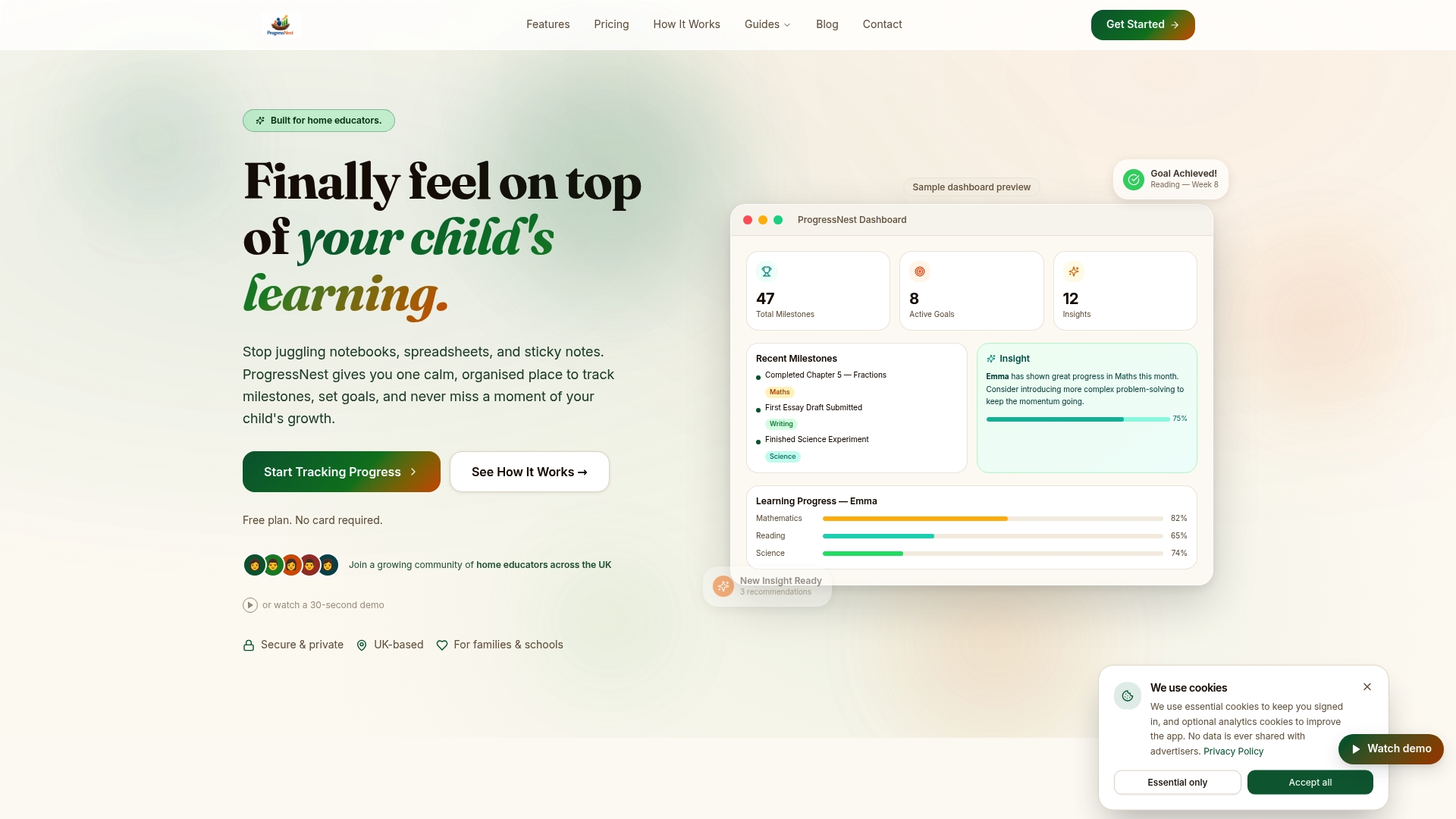
ProgressNest is built specifically for home-educating families in the UK. You can use our milestone tracker to log your child's achievements against clear educational stages, using language that aligns with official guidance. Our student progress monitoring tools let you generate professional PDF reports that speak the same language as your LA. Everything is secure, easy to use, and designed to give you confidence. Try ProgressNest free and see how organized home education can feel.
Frequently asked questions
What is the difference between EHE and homeschooling in the UK?
In the UK, Elective Home Education (EHE) is the official legal term, while "homeschooling" is an informal, widely used alternative. They refer to the same practice but EHE is the term you'll find in legal documents and LA communications.
Do parents need permission to home educate in the UK?
No. School is not mandatory, but education is, so parents can choose home education without seeking approval from anyone. You simply need to deregister your child if they are currently enrolled in school.
What does deregistration from school involve?
Deregistration means notifying the headteacher in writing that you are removing your child from the school roll. It is a straightforward written process and does not require the school's agreement.
Can home-educated children have an EHCP?
Yes. Home-educated children can hold or apply for an Education Health Care Plan (EHCP), and the LA retains certain responsibilities for provision even when a family chooses EHE.
How often will the local authority contact home-educating families?
LAs may make annual contact to check that your provision is suitable, but you are not legally required to allow access to your child or your home during these checks.
Recommended
- Blog — Home Education Tips & Child Progress Guides | ProgressNest
- 7 Things Every Home Educating Parent Wishes They'd Known Sooner | ProgressNest Blog
- How to Track Your Child's Educational Progress at Home | ProgressNest
- Educational Milestone Tracker for Children | ProgressNest — UK Parents & Home Educators