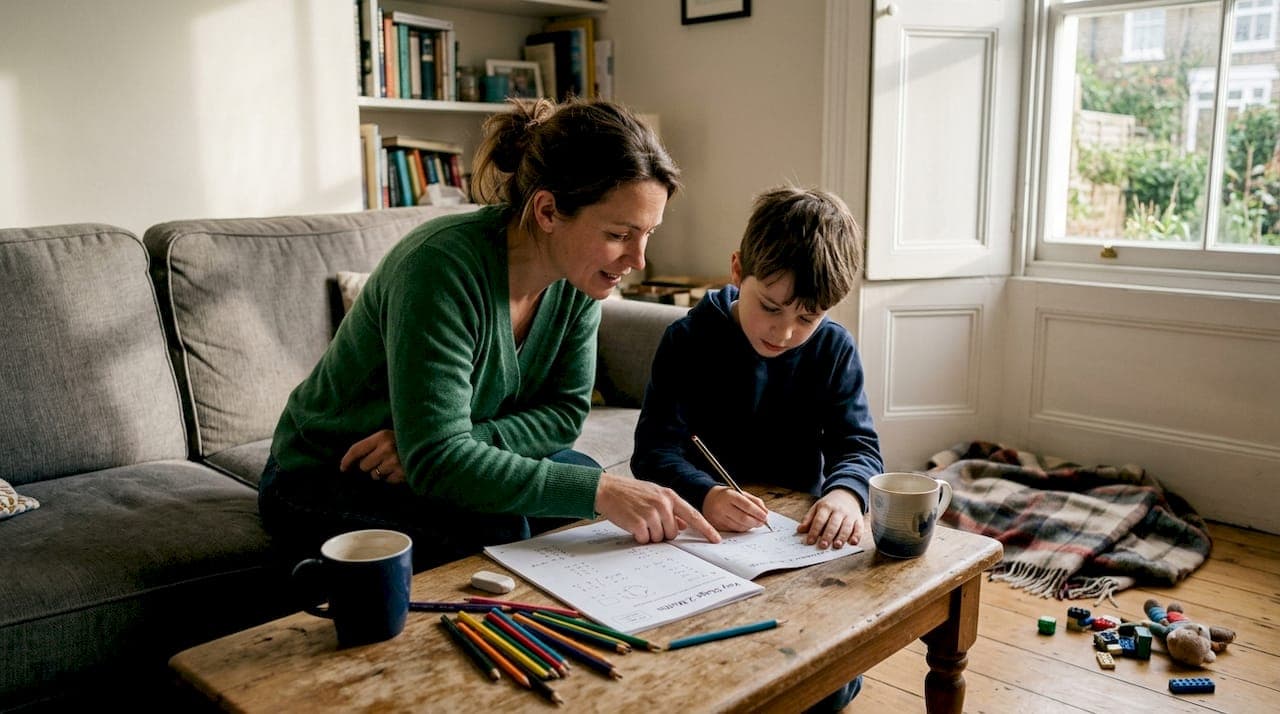
If you've spent any time researching home education, you've probably come across the term "learning styles." Maybe you've even tried to figure out whether your child is a "visual learner" or a "kinesthetic learner." Here's the thing: learning styles lack evidence for improving outcomes, with studies showing a negligible effect size of just d=0.04. What actually works is something different: learning patterns. Understanding the distinction can change how you plan, teach, and track your child's progress at home.
Table of Contents
- What are learning patterns?
- Why learning patterns matter in homeschooling
- Choosing and adapting effective learning patterns at home
- Tracking success: How to monitor and refine your child's learning patterns
- A fresh perspective: Why learning styles still linger and what to do instead
- Take the next step: Tools to support learning patterns at home
- Frequently asked questions
Key Takeaways
| Point | Details |
|---|---|
| Patterns beat styles | Evidence shows flexible learning patterns are more effective than fixed learning styles for UK homeschoolers. |
| Measure what matters | Track confidence, engagement, and progress using tools like portfolios and milestone dashboards. |
| Refine and adapt | The most successful home educators regularly update learning patterns based on observation and results. |
| Address challenges | Motivation and social isolation are common issues—incorporate outside activities to support your child. |
What are learning patterns?
Before we look at practical strategies, let's get clear on exactly what learning patterns are and what they aren't.
A learning pattern is a repeated approach, rhythm, or strategy that helps your child absorb new information and build skills over time. It's not a fixed label. It's an observable habit. Think of it like a child who consistently does better with short, focused sessions in the morning, or one who connects new ideas faster when they're tied to a real-life project.
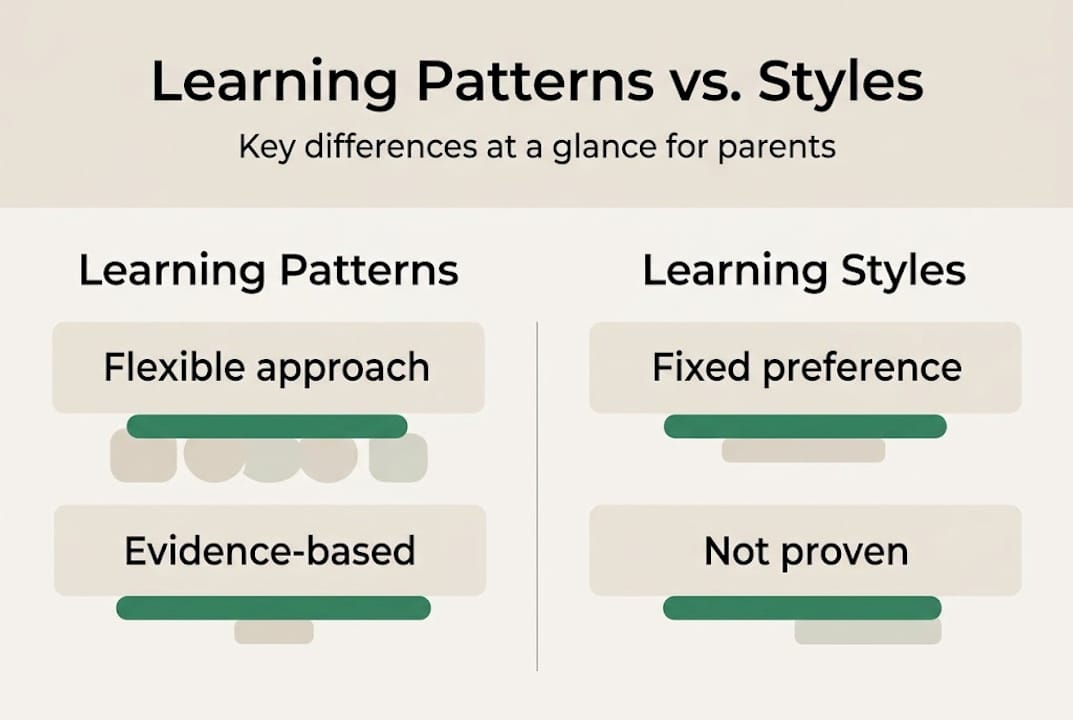
A learning style, by contrast, is the idea that each child has a fixed preference (visual, auditory, kinesthetic) and learns best only through that channel. It sounds intuitive. But empirical research debunks this model, finding negligible benefit when teaching is matched to a child's supposed style.
Here's a quick comparison to make it concrete:
| Feature | Learning patterns | Learning styles |
|---|---|---|
| Based on evidence? | Yes | No |
| Fixed or flexible? | Flexible | Fixed |
| Focuses on... | Observed behavior and strategy | Labeled preference |
| Adapts over time? | Yes | Rarely |
| Useful for tracking? | Very useful | Not useful |
The confusion between the two is widespread. Popular guides conflate styles and strategies regularly, which leaves many home educators building routines around categories that don't actually predict success.
So what do learning patterns look like in real home education? Here are some common ones:
- Short focused sessions: 20 to 30 minutes of concentrated work, followed by a break
- Weekly cycles: Rotating subjects across the week to keep engagement fresh
- Integrated projects: Connecting math, writing, and science through one real-world topic
- Spaced review: Revisiting material a few days later to strengthen memory
"The goal isn't to find your child's 'type.' It's to find what actually helps them move forward."
For more ideas on building routines that work, browse home education tips from families who've been there.
Why learning patterns matter in homeschooling
Now that you know what learning patterns are, let's see why they're especially powerful for home-educated children in the UK.
Home education gives you something most classroom teachers don't have: time to observe. You can notice when your child lights up, when they disengage, and when they retain information best. That's the raw material for building effective learning patterns.
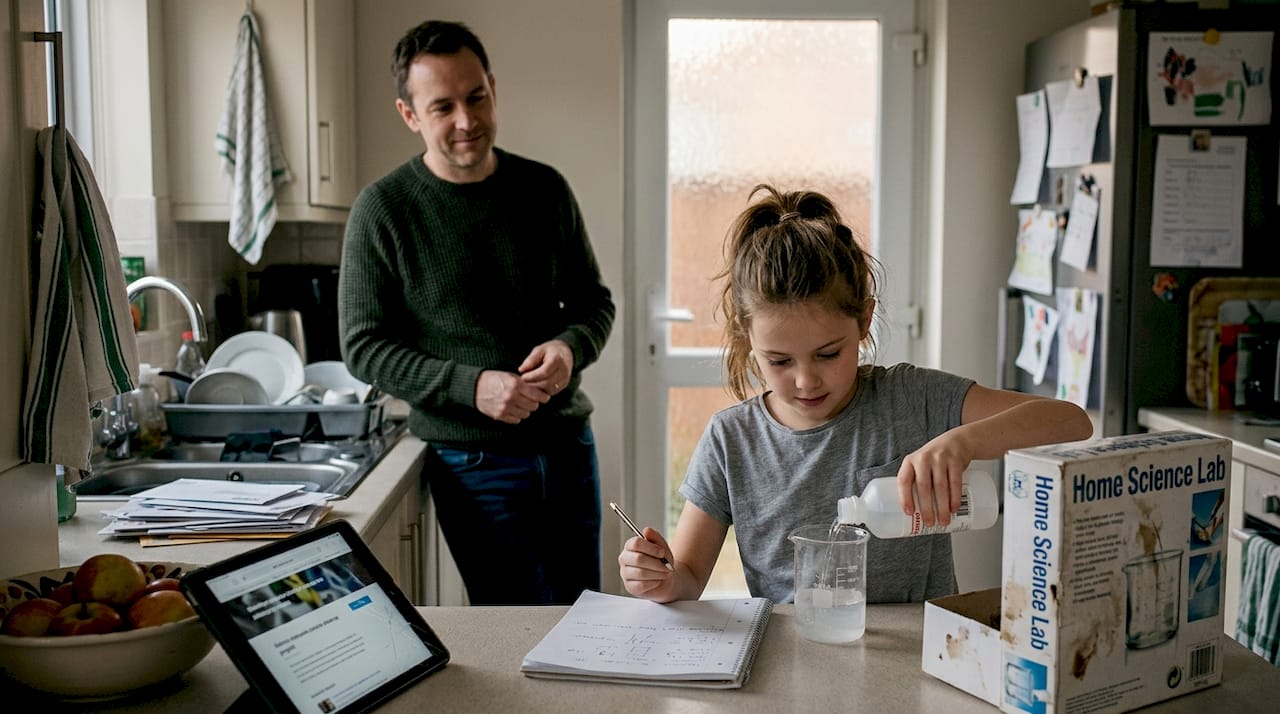
The data backs this up. UK homeschooled students are 83% confident in their progress, outpacing global peers. That confidence doesn't come from luck. It comes from personalized, adaptive learning environments that respond to each child's actual behavior.
Here's a snapshot of what UK home education looks like in practice:
| Factor | UK home education data |
|---|---|
| Student confidence in progress | 83% |
| Parents using online resources | High adoption |
| Common challenge: motivation | 29% of families |
| Common challenge: social isolation | 16 to 27% of families |
When you build learning patterns around what you observe rather than a fixed label, several things improve:
- Motivation stays higher because the routine fits the child, not the other way around
- Progress becomes visible because patterns create consistency you can measure
- Your child gains agency because they start to recognize how they learn best
- Adjustments are easier because you're working with real data, not assumptions
Adaptive, evidence-based patterns also beat fixed learning styles for one simple reason: children change. A pattern that works at age eight may not work at age eleven. Flexibility is built into the approach from the start.
Using a tool like student progress monitoring can help you spot these shifts early, so you adjust before a dip becomes a problem.
Choosing and adapting effective learning patterns at home
With the importance established, the next step is putting these patterns into real, adaptable routines at home.
Choosing a learning pattern isn't about picking from a menu. It's about watching your child and building from what you see. Here's a practical four-step process:
-
Observe first, plan second. Spend one or two weeks noting when your child is most focused, what types of tasks they finish without prompting, and where they consistently struggle. Don't assume. Watch.
-
Start with one pattern. Choose one rhythm to try, such as two focused 25-minute sessions in the morning with a longer project in the afternoon. Run it for two to three weeks before judging whether it works.
-
Layer in evidence-based techniques. Once your base pattern is running, add flexible lesson lengths and integrated projects. Try spaced retrieval (reviewing yesterday's material briefly before starting today's) and interleaving (mixing subjects within a session rather than blocking them).
-
Review and adjust regularly. Every three to four weeks, check in. Is your child finishing tasks with energy to spare, or dragging by midday? Adjust the session length, the subject order, or the project type accordingly.
A UK home educator might run this like a simple weekly rhythm: Monday and Tuesday for core subjects in short sessions, Wednesday for a real-world project (cooking with fractions, writing a local history report), Thursday for review and catch-up, and Friday for something creative or interest-led.
The key is to track child progress as you go, so your adjustments are based on evidence rather than guesswork. You can also find structured support through home education tips tailored to UK families.
Pro Tip: Watch for motivation dips. If your child suddenly resists a session type they used to enjoy, that's a signal the pattern needs a tweak, not a complete overhaul.
Tracking success: How to monitor and refine your child's learning patterns
Setting up learning patterns is only half the battle; ongoing tracking and tweaks are what powers real progress.
Tracking doesn't have to be complicated. In fact, the simpler your system, the more likely you are to use it consistently. Here are three reliable methods:
- Portfolio tracking: Collect samples of your child's work over time. Written pieces, drawings, math problems, project outputs. Reviewing these every few weeks shows growth that's easy to miss day to day.
- Confidence check-ins: Ask your child a simple question once a week: "What felt easy this week? What felt hard?" This surfaces both progress and early warning signs.
- Milestone timelines: Map key skills or topics you want your child to reach by the end of a term. Check off progress as it happens.
Using a feedback cycle keeps your patterns sharp. After each review, ask yourself: What's working? What's stalling? What needs to change?
Personalized learning patterns can outperform mainstream schooling when they're well tracked and consistently refined. The home learning environment is uniquely positioned for this because you can respond faster than any classroom teacher.
Two common obstacles are worth naming directly. Motivation challenges affect 29% of families, and social isolation is reported by 16 to 27% of home educators. Both can disrupt even well-designed patterns. For motivation, try rotating the order of subjects or introducing a short-term goal with a visible reward. For isolation, connect with local home education groups or co-ops to build social rhythm into your weekly pattern.
The parent progress dashboard and educational milestone tracker can make this process much easier, giving you a clear picture without hours of admin.
Pro Tip: Small, consistent changes beat sweeping overhauls. If something isn't working, adjust one variable at a time so you can tell what actually made the difference.
A fresh perspective: Why learning styles still linger and what to do instead
So why do so many resources still mention learning styles? Here's an honest look at the landscape.
The learning styles myth persists because it feels true. It gives children a clear identity and gives parents a simple framework. That's appealing, especially when you're starting out and everything feels uncertain. But learning styles are still pushed by popular homeschool guides even though research has consistently debunked them.
The real risk isn't just wasted time. It's that labeling your child as a "visual learner" or "auditory learner" quietly limits what you try. You stop experimenting. You stop adapting. And adaptation is exactly what makes home education so powerful.
Experienced home educators tend to shift away from labels over time. They start watching what their child actually does, not what category they fit. They adjust based on results, not assumptions. That shift, from fixed style to observed pattern, is where confidence and real progress start to build.
Trust the process. A child whose learning is tracked, reflected on, and adjusted regularly will grow in ways that a labeled, fixed approach simply can't match. For practical next steps, explore home education advice grounded in what actually works.
Take the next step: Tools to support learning patterns at home
Ready to elevate your child's learning patterns? Explore tools designed for UK home educators.
ProgressNest is built around exactly the kind of flexible, evidence-based tracking this article describes. You can log milestones, build portfolios, and spot patterns across weeks and months without touching a spreadsheet.
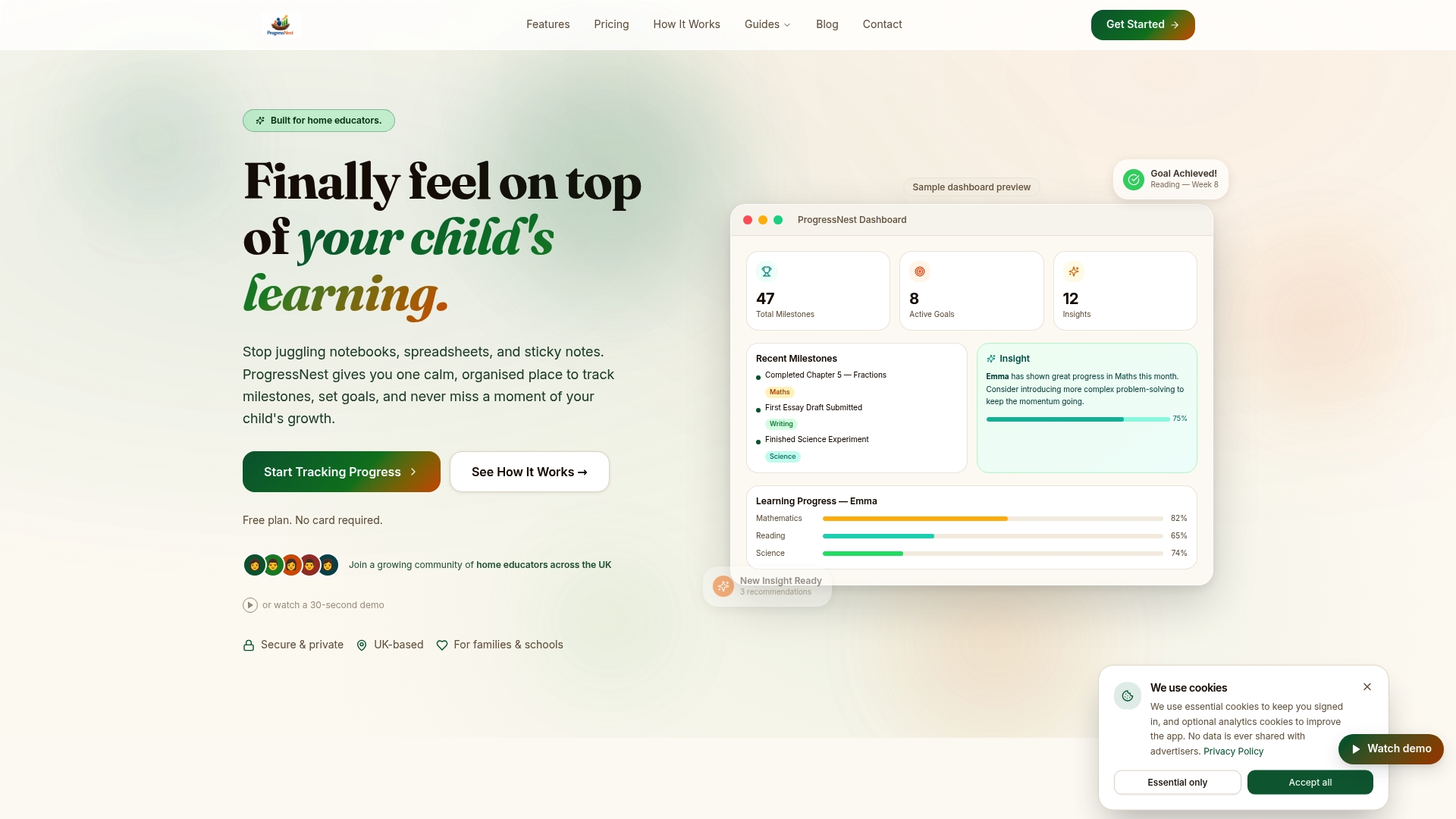
The child development tracker helps you see growth at a glance. The educational milestone tracker keeps your goals organized and visible. And the parent progress dashboard pulls it all together so you always know where your child stands. It's calm, organized, and built for the way home educators actually work.
Frequently asked questions
What is the difference between a learning pattern and a learning style?
A learning pattern is a flexible, observable routine or strategy that adapts as your child grows. A learning style is a debunked fixed-preference model with no evidence for improving outcomes.
How can I tell if my child's learning pattern is effective?
Look for growing confidence, steady portfolio progress, and willingness to engage. 83% of UK homeschooled students who follow personalized patterns report confidence in their progress, making these reliable indicators.
Do learning patterns help with motivation and socialization?
Yes. Flexible patterns keep routines fresh and reduce resistance. For social isolation, which affects 16 to 27% of UK home educators, pairing patterns with group activities or co-ops makes a real difference.
Can I change learning patterns if they stop working?
Absolutely. Adapting and refining patterns regularly is best practice. Personalized home learning consistently outperforms fixed approaches when it's tracked and adjusted over time.
Recommended
- Blog — Home Education Tips & Child Progress Guides | ProgressNest
- How to Track Your Child's Educational Progress at Home | ProgressNest
- 7 Things Every Home Educating Parent Wishes They'd Known Sooner | ProgressNest Blog
- Educational Milestone Tracker for Children | ProgressNest — UK Parents & Home Educators
- How to Teach Young Learners: A Practical Step-by-Step Guide - EBC TEFL courses