
Many UK homeschooling parents feel a quiet knot of worry when they think about tracking their child's learning and facing a local authority request. You want to do right by your child, but the rules can seem vague and the paperwork overwhelming. The good news is that the legal requirements are more flexible than most guides suggest, and with a calm, organized approach, you can document progress confidently. This guide walks you through exactly what the law requires, which tools work best, and how to present evidence that satisfies local authorities without turning your home into a bureaucratic office.
Table of Contents
- Know the legal requirements for homeschool progress tracking
- Gather tools and materials to track progress
- Step-by-step: How to track and report homeschool progress
- Troubleshooting: Common mistakes and how to avoid them
- Verifying and demonstrating progress: Satisfying local authorities
- Our perspective: What most guides miss about UK homeschool tracking
- How ProgressNest supports confident homeschool tracking
- Frequently asked questions
Key Takeaways
| Point | Details |
|---|---|
| Understand UK law | Legal requirements are flexible—no curriculum or test mandates, but evidence of progress is key. |
| Use practical tools | Simple trackers, logs, and portfolios make compliance less stressful and more consistent. |
| Follow a routine | Regular, weekly records and reviews help you stay prepared for official checks. |
| Avoid common pitfalls | Be proactive with recordkeeping and choose evidence types that best showcase your child’s growth. |
| Present confidently | Choose the right reporting method for your situation and know your rights with local authorities. |
Know the legal requirements for homeschool progress tracking
Before you build any system, it helps to understand what UK law actually asks of you. Many parents assume they need to replicate a school environment, complete with lesson plans, timetables, and qualified instructors. That is simply not the case.
Section 7 of the Education Act 1996 requires parents to provide efficient, full-time education that is suitable to their child's age, ability, aptitude, and any special educational needs. There is no legal requirement to follow the National Curriculum, administer tests, keep set hours, or use qualified teachers. The word "suitable" is doing a lot of work in that sentence, and it works in your favor.
Your local authority (LA) does have a role. Under its duty to identify children not receiving suitable education, an LA can make informal enquiries. But it has no automatic right to enter your home, inspect your records on demand, or require specific types of evidence. You can respond to any enquiry through a written report, a portfolio of your child's work, or an optional meeting.
Here is what that means practically:
- Written report: A clear summary of your child's learning activities, topics covered, and progress made.
- Portfolio: A curated collection of work samples, photos, or project outputs.
- Meeting: An optional face-to-face conversation, never compulsory.
"The law asks for suitable education, not perfect documentation. Your records just need to tell a clear, honest story of your child's growth."
Pro Tip: Document learning in ways that feel natural to your family first. A simple weekly note of what you covered and what your child achieved is often all you need to track child progress compliantly.
Gather tools and materials to track progress
Once you understand your obligations, the next step is choosing the right tools. The goal is a system that is easy to maintain week to week, not one that adds stress.

LAs contact families annually or as needed, asking for information on learning and progress via an online form, a written report, or an optional visit. That annual rhythm gives you time to build a solid record gradually rather than scrambling at the last minute.
Comparison: Digital vs. paper tracking
| Feature | Digital tracker | Paper portfolio |
|---|---|---|
| Ease of updating | Very easy, anywhere | Requires physical access |
| Cost | Free to low monthly fee | Minimal, just supplies |
| Organization | Automated and searchable | Manual filing required |
| LA acceptance | Widely accepted as PDF | Widely accepted |
| Risk of loss | Low with cloud backup | Higher if not copied |
A milestone tracker lets you log achievements as they happen, while a parent dashboard gives you an at-a-glance view of each child's progress over time. For families tracking development across multiple subjects, a development tracker can organize everything in one place.
Must-have evidence types to collect regularly:
- Work samples: Drawings, written pieces, science experiments, math workbooks.
- Activity logs: Brief notes on books read, outings, projects, and discussions.
- Written reflections: A short paragraph from you or your child about what was learned.
- Photos or videos: Especially useful for practical or creative subjects.
For families who want a polished finish, a diploma cover can present milestone certificates professionally.
Pro Tip: Set aside ten minutes every Friday to update your records. Consistent weekly notes are far easier than trying to reconstruct a month's worth of learning from memory.
Step-by-step: How to track and report homeschool progress
With the right tools in hand, you are ready to build a repeatable workflow. A clear process takes the guesswork out of both daily recording and official reporting.
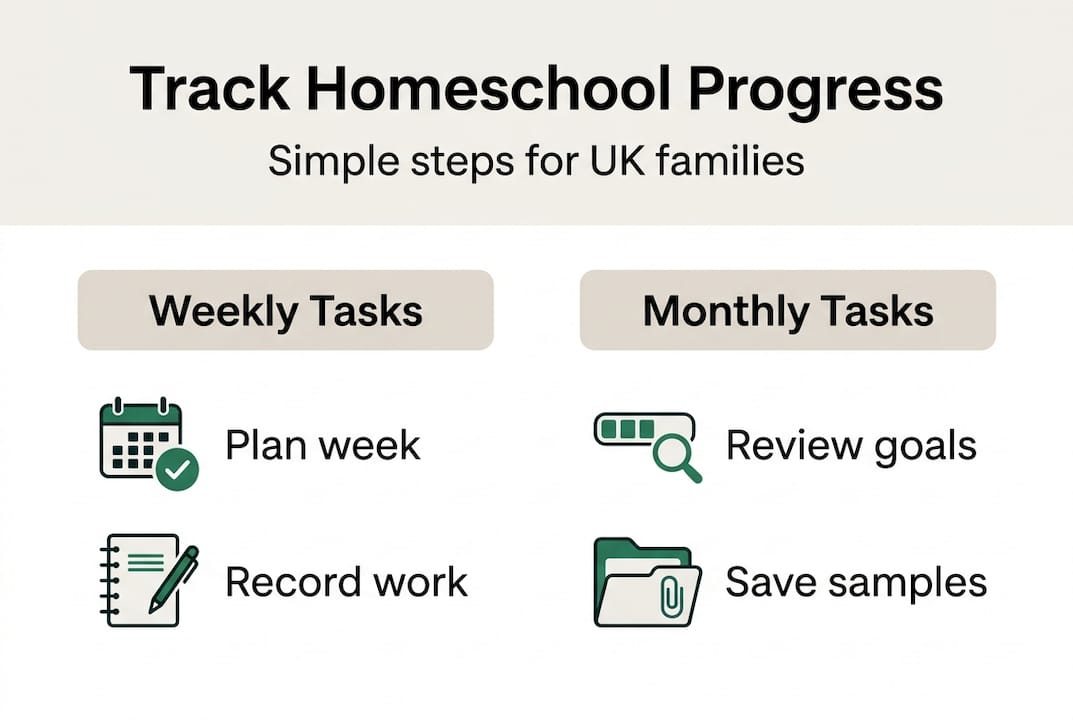
- Plan your learning week. Outline topics, activities, and goals for the coming week. Keep it brief. A simple list works fine.
- Record as you go. Note what you actually did each day, not just what you planned. Real evidence beats perfect plans.
- Collect evidence weekly. Save work samples, photos, or brief written notes in one folder, physical or digital.
- Review monthly. Spend 20 minutes each month checking whether your child is making progress in core areas. Adjust if needed.
- Prepare your report quarterly. Compile your evidence into a clear summary. Update your track child progress record and export a report from your parent dashboard if you use a digital tool.
- Respond to LA requests calmly. Use your quarterly summary as the basis for any written report, portfolio, or meeting.
Step summary table
| Step | Frequency | Time needed |
|---|---|---|
| Plan learning week | Weekly | 15 minutes |
| Record activities | Daily | 5 minutes |
| Collect evidence | Weekly | 10 minutes |
| Monthly review | Monthly | 20 minutes |
| Prepare report | Quarterly | 1 to 2 hours |
One thing many parents ask is how to gauge progress without standardized tests. There are no national benchmarks specifically for home-educated children. For context, 62% of school pupils met the expected standard in reading, writing, and math combined in 2024/25. You are not required to hit that bar, but it can serve as a loose reference point if you want one.
Also worth noting: the Children's Wellbeing and Schools Bill for 2024/25 introduces mandatory LA registers for children not in school, potentially including details on learning hours and providers. Logging your activities consistently now puts you well ahead of any increased oversight requirements.
"A simple, honest log of what your child does each week is your most powerful compliance tool."
Troubleshooting: Common mistakes and how to avoid them
Even parents with the best intentions run into problems. Here are the most common mistakes and how to fix them before they become real issues.
Common mistakes:
- Inconsistent recording. Gaps in your log make it hard to tell a clear story of progress.
- Unclear evidence. A pile of unlabeled worksheets tells an LA very little. Label each piece with the date, subject, and what your child was learning.
- Waiting for an official request. Some parents only start organizing records when an LA letter arrives. That leads to stress and weak reports.
- Over-complicating the system. A 20-page weekly planner is not more compliant than a simple notebook. Complexity often leads to abandonment.
- Missing deadlines. If an LA sets a response deadline, missing it can escalate the situation unnecessarily.
How to fix each one:
- Use a simple template for weekly notes. Consistency beats perfection.
- Label work samples the moment you file them.
- Review your home education tips and set a quarterly reminder to audit your records.
- Keep your system as simple as possible and build up only if you need to.
- Add LA correspondence deadlines to your calendar the moment a letter arrives.
Research shows that 79% of homeschooled students feel their setup is effective, and 76% feel confident in their progress. That confidence comes from consistent habits, not from perfect paperwork. Check the progress tips on our blog for more practical guidance.
Pro Tip: Do not wait for an official request to get organized. Treat your records as a living document you update weekly. When an LA letter arrives, you will feel calm and ready.
Verifying and demonstrating progress: Satisfying local authorities
You have tracked progress and avoided the common pitfalls. Now it is time to make sure you can present your evidence clearly and confidently.
Parents can respond to LA enquiries via a written report, a portfolio, or an optional meeting. LAs make informal enquiries but have no automatic right of entry into your home.
Choose your response format based on your situation:
- Written report: Best if your child's learning is mostly text or project-based. Keep it factual, structured, and no longer than two to three pages.
- Portfolio: Ideal for hands-on, creative, or project-based learners. Organize it by subject or theme with clear labels and dates.
- Meeting: Only if you feel it will help clarify your approach. You are never obliged to agree to one.
Best practices for presenting evidence:
- Open with a brief summary of your educational philosophy and approach.
- Group evidence by subject area or learning goal.
- Include a short note on each item explaining what your child was learning and what progress was made.
- Use clear, professional formatting. A tidy PDF report makes a strong impression.
If the LA asks for more information after your initial response, you can ask specifically what they need. You are not required to provide open-ended access to all your records. A learning tracker that generates polished reports on demand makes this process far less stressful.
"Know your rights. A polite, well-organized written response is almost always enough to satisfy an LA enquiry."
Our perspective: What most guides miss about UK homeschool tracking
Most tracking guides focus on compliance checklists. But here is what we have learned from working with UK home educators: the families who feel most confident are not the ones with the thickest portfolios. They are the ones who track progress for their child, not for the LA.
When you shift your mindset from "what does the authority want to see" to "what shows my child's genuine growth," your records become richer and more authentic. An LA can spot a manufactured paper trail. What reassures an officer is a parent who clearly knows their child's learning journey, speaks about it with calm confidence, and has organized evidence to back it up.
Over-documenting is a real risk. Families who spend hours each week on records often burn out, and the quality of their teaching suffers. A well-maintained educational milestone tracker that captures real moments of learning is worth ten binders of generic worksheets.
Trust your approach. UK law is on your side. The framework is flexible by design, and your child's progress is yours to define.
How ProgressNest supports confident homeschool tracking
Ready to put these strategies into action? ProgressNest is built specifically for UK home educators who want to stay organized, calm, and compliance-ready without drowning in spreadsheets.
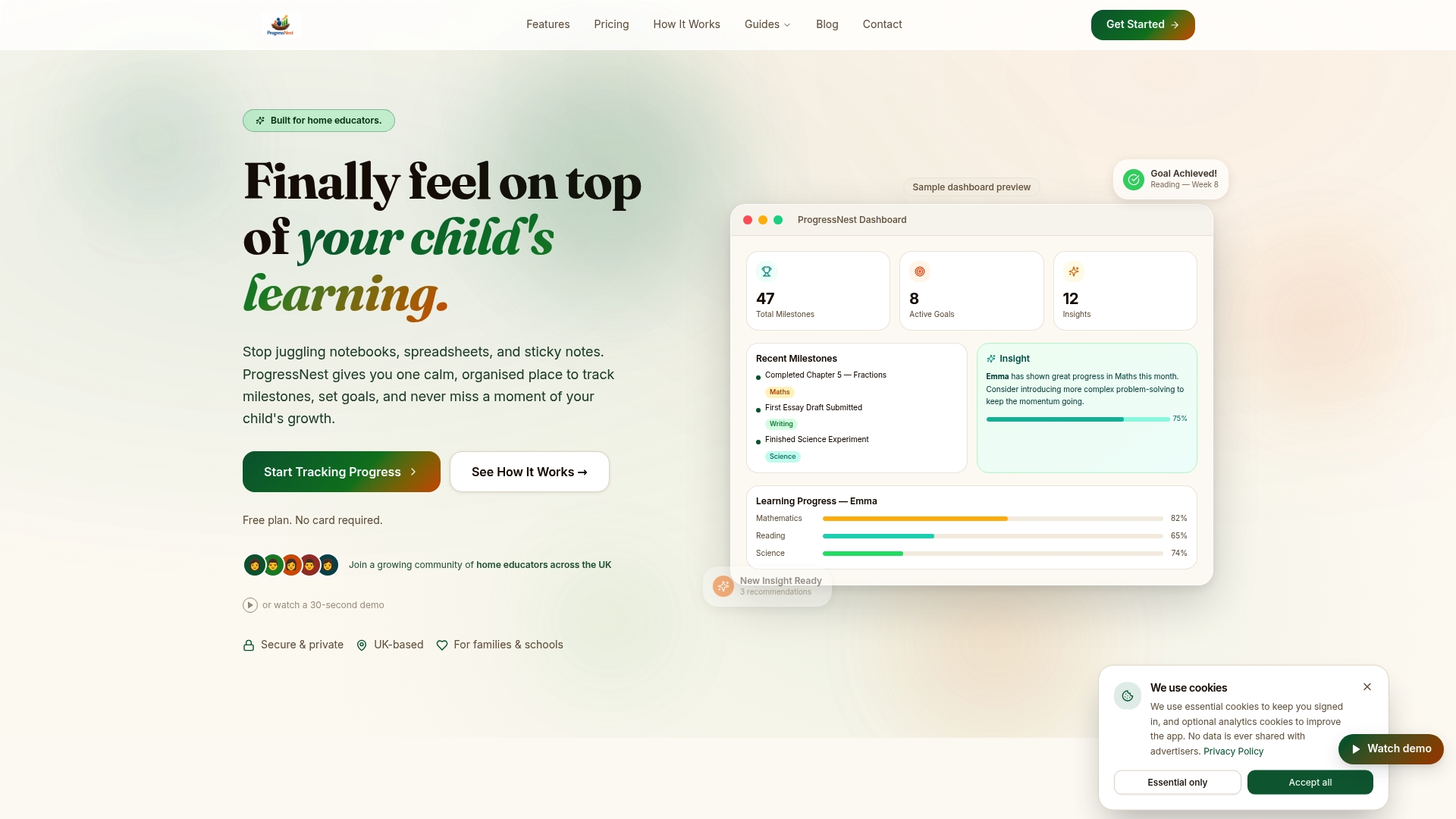
With ProgressNest, you can log milestones using our educational milestone tracker, monitor each child's learning patterns through student progress monitoring, and generate professional PDF reports directly from your parent progress dashboard. Everything is secure, private, and designed around the way UK home educators actually work. When an LA request arrives, your report is ready in minutes, not days. Try ProgressNest free and feel the difference that calm, organized tracking makes. 🎯
Frequently asked questions
Do I have to follow the National Curriculum when homeschooling in the UK?
No. UK law requires a suitable education but places no obligation on parents to follow the National Curriculum, administer tests, or use qualified teachers. You set the approach that fits your child best.
How often will the local authority check my homeschool progress?
LAs contact families annually or as circumstances require, starting with informal enquiries rather than formal inspections. Keeping regular records means you are always ready to respond.
What kinds of evidence are best for showing homeschool progress?
Work samples, activity logs, written reports, and portfolios are all widely accepted. Choose the format that reflects your child's learning most honestly, as parents can respond via whichever method suits them best.
Can the local authority demand to visit my home or meet my child?
No. LAs have no automatic right to enter your home or insist on a meeting. A clear written report or portfolio is usually sufficient to satisfy an enquiry.
Recommended
- How to Track Your Child's Educational Progress at Home | ProgressNest
- Educational Milestone Tracker for Children | ProgressNest — UK Parents & Home Educators
- Parent Progress Dashboard | Monitor Your Child's Learning in One Place | ProgressNest
- Child Learning Tracker | ProgressNest Dashboard
- Guide to preschool learning at home for East London families