
Most people assume formal schooling is the gold standard for tracking a child's academic progress. But 83% of UK homeschooled students report feeling confident in their progress, which challenges that assumption directly. If you are managing the education of two or more children at home, you already know how quickly things can feel scattered. Tracking learning milestones gives you a clear, calm picture of where each child stands. This guide walks you through what milestones are, why they matter legally, how to track them across multiple children, and how to use that data to celebrate wins and close gaps early.
Table of Contents
- What are learning milestones and why do they matter?
- Legal benefits: Navigating UK oversight with confidence
- Effective strategies for multi-child milestone tracking
- Spotting gaps and celebrating progress
- A parent-educator perspective: What tracking really teaches us
- Discover easier milestone tracking with ProgressNest
- Frequently asked questions
Key Takeaways
| Point | Details |
|---|---|
| Boosts academic success | Tracking milestones helps spot gaps early and ensures steady learning progress for each child. |
| Simplifies legal oversight | Documented milestones make responding to local authority enquiries less stressful. |
| Efficient for large families | Using the right tools streamlines tracking across multiple children with diverse needs. |
| Fosters motivation | Celebrating achievements keeps children engaged and confident in their home education journey. |
What are learning milestones and why do they matter?
A learning milestone is a specific, measurable achievement that signals a child has reached a new stage in their development. Think of things like reading independently at age 7, completing two-digit multiplication by age 9, or writing a structured paragraph by age 10. These are not arbitrary checkboxes. They are meaningful markers that show growth over time.
In a home education setting, milestones serve a different purpose than they do in a traditional classroom. You are not working toward a term report or a standardized test on a fixed date. Instead, you are building a living record of your child's learning journey. That record becomes your most valuable tool, especially when you have more than one child moving at different speeds.
Here is why milestones matter so much for home educators:
- Structure without rigidity. Milestones give your days a sense of direction without locking you into a rigid schedule.
- Early identification of gaps. When you log progress regularly, you spot where a child is struggling before it becomes a bigger problem.
- Celebrating real growth. Each milestone reached is a genuine win worth acknowledging, which builds a child's confidence.
- Tailored learning. Tracking shows you where one child is racing ahead and another needs more support, so you can adjust your approach.
- Legal protection. A clear record of milestones helps demonstrate that your children are receiving a suitable education.
Using an educational milestone tracker makes this process far more organized than a notebook or a pile of worksheets ever could. You can log achievements, add notes, and build a timeline that tells a real story.
"Tracking learning milestones ensures steady academic progress and identifies gaps early in homeschooling."
A child development tracker also helps you see the full picture beyond academics, including social skills, creative development, and emotional growth. When you track all of these together, you get a genuinely rounded view of how your child is thriving.
Legal benefits: Navigating UK oversight with confidence
One of the biggest sources of stress for home educators in the UK is the question of legal compliance. What do you actually need to show? What can a local authority (LA) ask of you? Understanding this clearly makes a huge difference to your peace of mind.
In England, parents are legally responsible for ensuring their children receive a suitable, full-time education. You do not need to follow the national curriculum, and you do not need to replicate a school day. But if your LA contacts you, you do need to be able to demonstrate that your children are learning. Tracking provides evidence for local authority enquiries to demonstrate suitable education under UK law.
Here is a clear comparison of what traditional schooling provides versus what home educators need to prepare:
| Evidence type | Traditional school | Home education |
|---|---|---|
| Attendance records | Automatic | Not required |
| Progress reports | Termly | Self-generated |
| Curriculum coverage | National curriculum | Parent-chosen |
| Assessment data | Standardized tests | Portfolio or tracker |
| LA contact | Not applicable | Recommended annually |
UK LAs have no statutory monitoring duty but recommend annual contact, and parents are not obliged to allow home visits. This means you have more control than many people realize. But that control comes with responsibility. Keeping organized records is your best defense and your clearest proof.
Pro Tip: Set up a dedicated folder, either digital or physical, for each child. Include milestone logs, work samples, and a brief monthly summary. This makes any LA interaction calm and straightforward rather than stressful.
A parent progress dashboard lets you pull together all of this information in one place. You can generate clean, professional reports without spending hours formatting documents. If you ever need to present formal records, looking at diploma documentation best practices can also give you a sense of how to present educational achievements clearly and credibly.
Effective strategies for multi-child milestone tracking
Managing the learning journeys of two or more children is genuinely complex. Each child has different strengths, different speeds, and different interests. Without a system, it is easy to give more attention to the child who is struggling and accidentally overlook the one who is quietly coasting.

126,000 children in elective home education were registered in England in autumn 2025. That is a significant community of families navigating exactly this challenge. The good news is that practical systems exist to make it manageable.
Here is a simple step-by-step routine you can start this week:
- Set up a profile for each child. List their current stage, key subjects, and three to five milestones to work toward this term.
- Log progress weekly, not daily. Daily logging feels overwhelming. A weekly check-in keeps the habit sustainable.
- Use a shared template. A consistent format across all your children makes comparison easy and saves time.
- Review monthly. Look at the bigger picture once a month to spot trends and adjust your plans.
- Celebrate completions. When a milestone is reached, mark it clearly and acknowledge it with your child.
Here is an example tracking framework for two children at different stages:
| Subject | Child A (age 8) | Child B (age 11) | Review frequency |
|---|---|---|---|
| Reading | Chapter books independently | Analyzing fiction texts | Weekly |
| Math | Times tables to 12 | Fractions and decimals | Weekly |
| Writing | Structured sentences | Essay paragraphs | Bi-weekly |
| Science | Basic experiments | Research projects | Monthly |
| Creative | Art and craft projects | Music or drama | Monthly |
You can track child progress digitally so every update is stored safely and accessible whenever you need it. For broader support and ideas, the home education tips blog is a great resource. If you are newer to this, the teaching young learners guide offers solid foundational strategies for structuring learning at home.
Spotting gaps and celebrating progress
Tracking milestones is not just about compliance or organization. It is one of the most powerful tools you have for genuinely supporting your children's growth. When you log progress consistently, patterns emerge quickly.
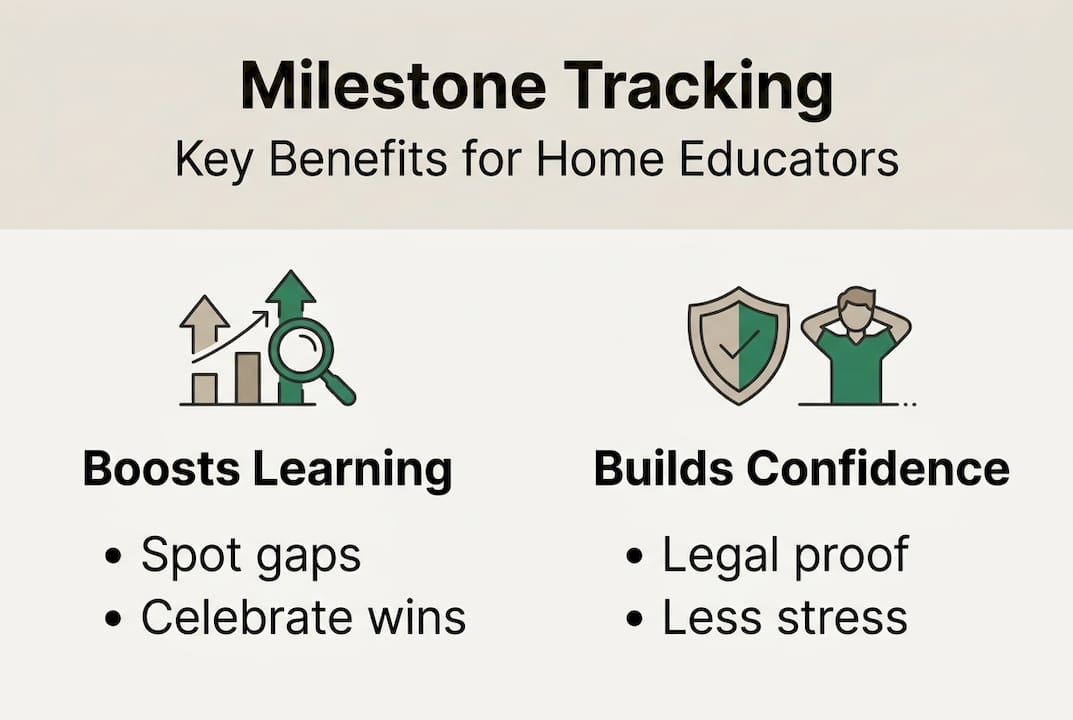
Maybe your daughter Emma is flying through science but stalling on reading comprehension. Without a tracker, you might not notice until she is frustrated and behind. With regular logging, you catch it early and adjust your approach before it becomes a real obstacle. Tracking learning milestones ensures steady academic progress and identifies gaps early in homeschooling.
And the flip side is just as important. Tracking lets you celebrate. 78% of US studies show homeschooled children score 15 to 30 percent higher on exams than their school-going peers. That kind of performance does not happen by accident. It comes from consistent attention, personalized learning, and the motivation that comes from seeing real progress.
Here are tangible progress markers worth celebrating with your children:
- Reading their first full chapter book without help
- Writing a story from beginning to end independently
- Solving a math problem type they previously found impossible
- Completing a science experiment and explaining the results
- Finishing a creative project they chose themselves
- Demonstrating a new skill to a sibling or family member
Pro Tip: Use visual progress charts your children can see and update themselves. When a child physically moves a sticker or checks a box, they feel ownership over their learning. That feeling of ownership is one of the strongest motivators you can build.
Understanding how milestone tracking works in a structured platform can show you just how simple this process can be. And with student progress monitoring tools, you can generate visual summaries that make growth visible and exciting for the whole family.
A parent-educator perspective: What tracking really teaches us
Here is something most milestone guides will not tell you: tracking is not primarily about the data. It is about the reflection it forces you to do as an educator.
When you sit down each week to log what your children have achieved, you are not just recording facts. You are asking yourself, "Did this approach actually work? Is my child growing, or are we just busy?" That question is uncomfortable. But it is the most important one you can ask.
Many home educators fall into the trap of equating activity with progress. A full schedule feels productive. But tracking reveals the truth. If a milestone has not moved in six weeks, something needs to change, and the tracker gives you the evidence to act on that feeling rather than second-guess it.
The deeper lesson is this: tracking teaches you to follow your child, not your plan. It builds flexibility into your practice. And it shifts your focus from "covering material" to genuinely facilitating growth. That shift is what separates good home education from great home education. For real-life home education lessons from families who have been through it, you will find honest, practical stories that reinforce this point.
Discover easier milestone tracking with ProgressNest
You have done the hard work of understanding why milestones matter and how to track them well. Now it is time to make that process as easy and stress-free as possible.
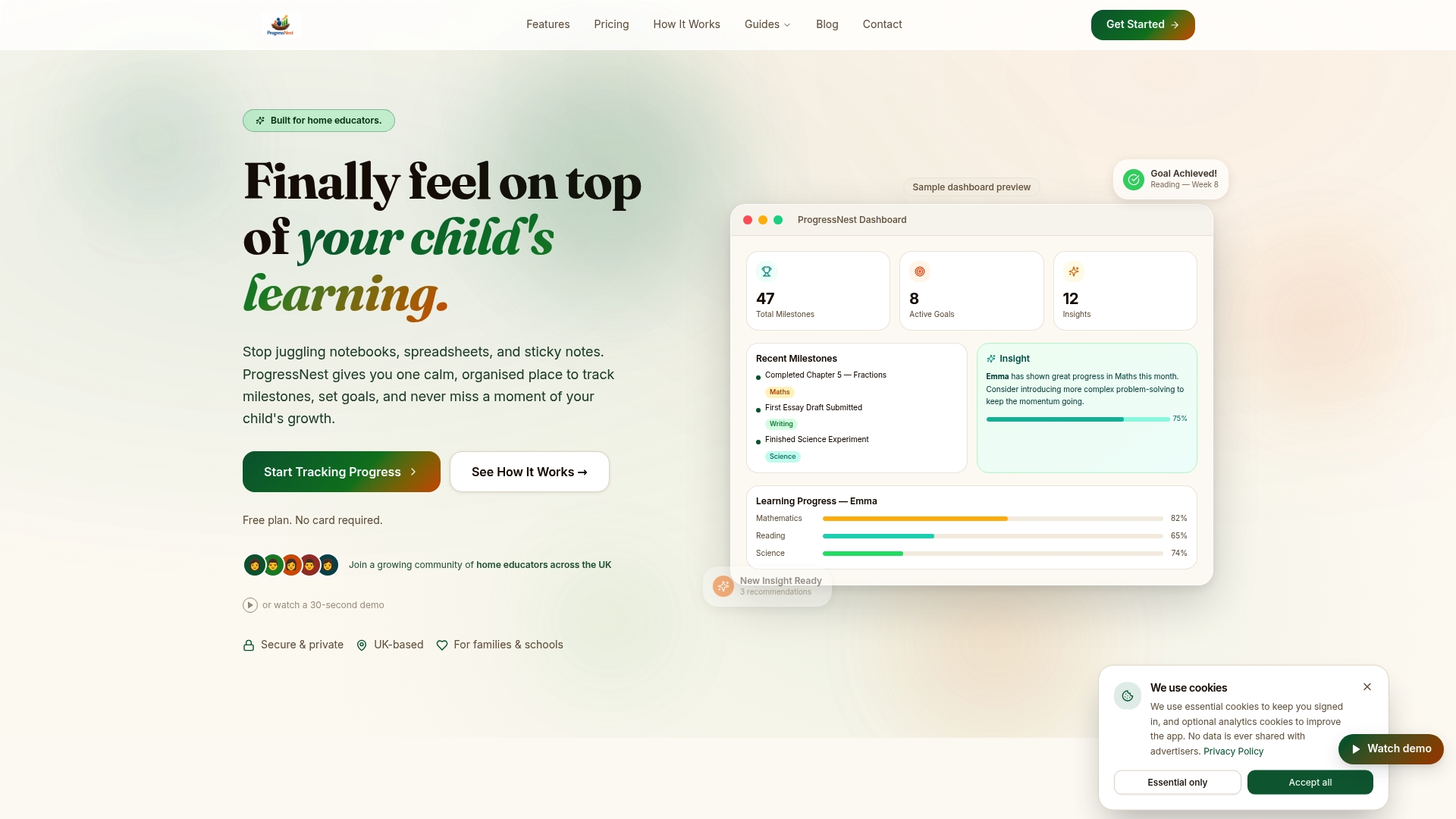
ProgressNest is built specifically for home educators managing multiple children. You can log milestones, set goals, and generate professional PDF reports without touching a spreadsheet. The milestone tracker keeps every child's journey organized in one secure place. The parent progress dashboard gives you a calm, clear overview at a glance. And student progress monitoring tools help you spot trends and celebrate wins automatically. Try ProgressNest free and see how much calmer your home education routine can feel. 🎯
Frequently asked questions
What is a learning milestone in home education?
A learning milestone is a specific academic or developmental achievement, like reading independently or mastering division, mapped to a child's age or stage. Tracking these milestones ensures steady progress and helps identify gaps early.
How can tracking milestones help during local authority (LA) enquiries?
Detailed records of milestones provide legal evidence of a suitable education, making LA enquiries much smoother for home educators. Tracking provides evidence that demonstrates compliance with UK law clearly and confidently.
Are UK home educators required to report learning milestones to authorities every year?
No, UK law does not require annual milestone reports or home visits, but tracking is strongly advised for best practice. UK LAs have no statutory monitoring duty but do recommend annual contact with home educating families.
What tools make milestone tracking easier for families with multiple children?
Digital trackers, progress dashboards, and shared templates help organize milestones efficiently across different ages and subjects. Platforms designed for home educators remove the need for spreadsheets entirely.
Does research show homeschooled children keep up academically?
Yes, studies show most homeschooled children are confident in their progress and often outperform their peers academically. 83% of UK homeschooled students feel confident in their progress, and US research shows consistent exam score advantages of 15 to 30 percent.
Recommended
- Educational Milestone Tracker for Children | ProgressNest — UK Parents & Home Educators
- How to Track Your Child's Educational Progress at Home | ProgressNest
- Child Learning Tracker | ProgressNest Dashboard
- Child Development Tracker for Parents | Monitor Growth & Learning | ProgressNest
- Why should we be motivated to learn? Two “I”s for teaching - EBC TEFL